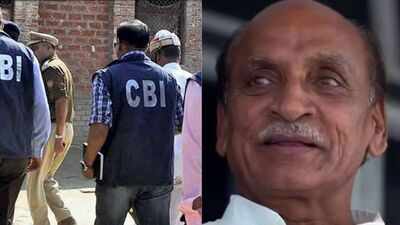
NEW DELHI: The Central Bureau of Investigation (CBI) will appeal against the acquittal of all accused in the 2006 Pawanraje Nimbalkar double murder case before the Bombay high court, Maharashtra deputy chief minister Eknath Shinde said on Saturday, hours after a special CBI court cleared nine accused, including former NCP leader Padamsinh Patil.The acquittal came nearly two decades after Congress leader Pawanraje Nimbalkar and his driver Samad Kazi were shot dead in Navi Mumbai in June 2006. The trial saw the examination of 128 witnesses and became one of Maharashtra’s most closely watched political murder cases.Also read: 20 years, 128 witnesses later, Sunetra Pawar’s brother Padamsinh Patil acquitted in Congress leader Pavanraje Nimbalkar murder caseSpeaking to ANI, Shinde said the state government had already spoken to Union Home Minister Amit Shah regarding the verdict.“I myself, and chief minister Devendra Fadnavis, have spoken with Union home minister Amit Shah. Amit Shah ji has stated that the CBI will appeal this decision in the High Court and contest the case. The Union Home Minister has issued these instructions to the CBI,” Shinde said.Expressing disappointment over the verdict, Shinde said the family had expected the accused to be convicted.“This is a very unfortunate incident; it is a very tragic event because Pawanraje Nimbalkar ji and two others were murdered in broad daylight. This was a very serious and grave matter. The family and many others believed that the accused would be punished. However, unfortunately, the CBI court has acquitted them,” he said.The special CBI court acquitted all nine accused, including Padamsinh Patil, brother of Maharashtra deputy chief minister Sunetra Pawar and a former state minister. Patil had been accused of masterminding the killing of his cousin, Pawanraje Nimbalkar, allegedly over political and business rivalry.Special Judge SR Navandar based the acquittal largely on the failure of the prosecution’s key witness, accused-turned-approver Parasmal Jain. According to court observations reported by TOI, the judge discarded Jain’s testimony, describing him as unreliable and noting inconsistencies in his statements throughout the trial.The court observed that 127 witnesses had deposed before Jain became the 128th witness after turning approver and receiving a pardon. However, the judge found several aspects of his testimony doubtful, including his claims regarding the planning and execution of the murder.The court also held that the prosecution failed to conclusively establish that the vehicle seized during the investigation was the same one used in the crime. It further noted there was no evidence to support the claim that Jain had contacted Nimbalkar from a public call office before the murder under the pretext of a land deal.The CBI had argued that Nimbalkar’s murder was the result of long-standing political rivalry with Patil. The prosecution alleged that the conflict stemmed from disputes over the management of the Terna Sugar Factory and Nimbalkar’s decision to contest against Patil in the 2004 Maharashtra Assembly elections.Nimbalkar was shot dead on June 3, 2006, while travelling on the Mumbai-Pune Expressway. His driver, Samad Kazi, was also killed in the attack.The investigation was transferred to the CBI in 2008 after the Bombay high court, acting on a petition filed by Nimbalkar’s wife Anandibai Nimbalkar, criticised the state police probe as “desultory and lackadaisical”. The trial was later shifted following allegations that Patil was exerting influence over the proceedings.The approver had alleged that he was recruited by two associates of Patil to coordinate the contract killing and had provided details about the recruitment of shooters from Uttar Pradesh, the purchase of a vehicle under an assumed identity and surveillance of Nimbalkar before the attack.The verdict also carries political significance because Pawanraje Nimbalkar was the father of Shiv Sena (UBT) MP Omprakash Rajenimbalkar, who was present in court along with family members when the judgment was delivered.The case has remained a focal point in Maharashtra politics for nearly 20 years, intertwining allegations of political rivalry, influence and a prolonged legal battle. With the CBI now set to challenge the acquittal before the Bombay high court, the legal fight over one of the state’s most prominent political murder cases appears far from over.