
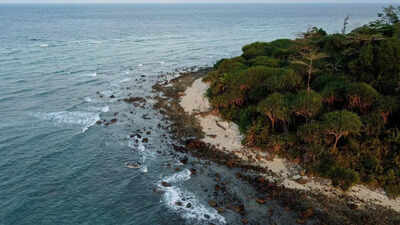
NEW DELHI: Considering the strategic and economic benefits of Great Nicobar Islands (GNI) development projects, the greenfield airport approved by the Cabinet last November “is expected to be ready within five years and will be under the operational control of the Indian Navy,” defence sources have said.“The dual-use airport to be used for civilian and military purposes shall enhance India’s maritime domain awareness and operational outreach,” the sources said, adding, “initial tendering is underway for the airport. Other projects are in the pipeline.”For holistic development of GNI, three interlinked projects besides the greenfield airfield and naval air station have been envisaged are International Container Transhipment Port (ICTP), a township and a power plant. The total cost of all four projects is estimated at Rs 81,000 crore. “The GNI project is even more important due to potentially important hydrocarbon deposits in the sea near the islands,” a source said.Highlighting its strategic importance, the source said the project would grant India the ability to sustain its presence, move its assets, support operations, and monitor and maintain forward logistics close to its theatre of interest. “The project should have been executed 30 years ago,” the sources said.The runway at INS Baaz, the Indian naval air station in A&N Islands, will not be part of the GNI project. The possibility of INS Baaz being developed as a brownfield project met with limitations, which forced the idea to be dropped. The site is dominated by a hill feature on the north, which is over 80m high. Significant hill cutting and dredging of the shallow coastline would have been required to ensure safe aviation for wide-bodied aircraft. The site has a limited scope for future expansion and would not be able to accommodate the infrastructure required for an international airport.The GNI is located only 40 km from the Six Degree Channel astride the sea trade route, which extends from the Gulf of Aden to the Malacca Straits. Two-thirds of the world’s oil and half of the world’s container traffic pass through this sensitive area. Various regional and extra-regional powers have increased their military and economic presence in the IOR. In view of this, GNI project shall augment India’s ability to operate in the south-eastern IOR, thereby enhancing its stature as a preferred security partner and as a first responder.On allegations of commercial reasons driving the project, the source said, “Criticism that it is a commercial project being disguised as a strategic one is based on geographical illiteracy.” Besides the strategic reason, govt’s focus is on GNI’s overall development. Allegations that “projects are being awarded directly to private entities are false. The projects are being undertaken through proper contracting.”Giving updates on the progress of different GNI projects, the source said, “While for ICTP public-private partnership appraisal committee appraisal has been done and a draft cabinet note submitted by ministry of ports, shipping and waterways to finance ministry, for the township, the expenditure finance committee meeting was conducted last week. For the LNG-based power project, a detailed project report has been prepared and shall be cleared by the NTPC board. Cabinet approval for the power plant is not required.”An environmental impact assessment recorded that only 166.1 sq. km. has been designated for development of the GNI project, while 81.74% of the island area will continue under national parks, the Great Nicobar biosphere reserve, forests and tribal conservation areas. The project involves forest diversion of about 130.75 sq. km. , out of which more than half will be retained as green area, where no tree felling is envisaged,” they said. Forest land will be diverted for non-forest purposes only as “right of use” and the ownership of the balance non-forest land will remain with the govt in terms of the provisions of the Forest Conservation Rules 2023.A dedicated conservation programme of 2,220.41 crore over 30 years has been provisioned to ensure sustained protection of wildlife, flora and ecosystems, including Leatherback Turtles, Nicobar Megapodes and Crocodiles and facilitate coral conservation & mangrove restoration, the sources said.