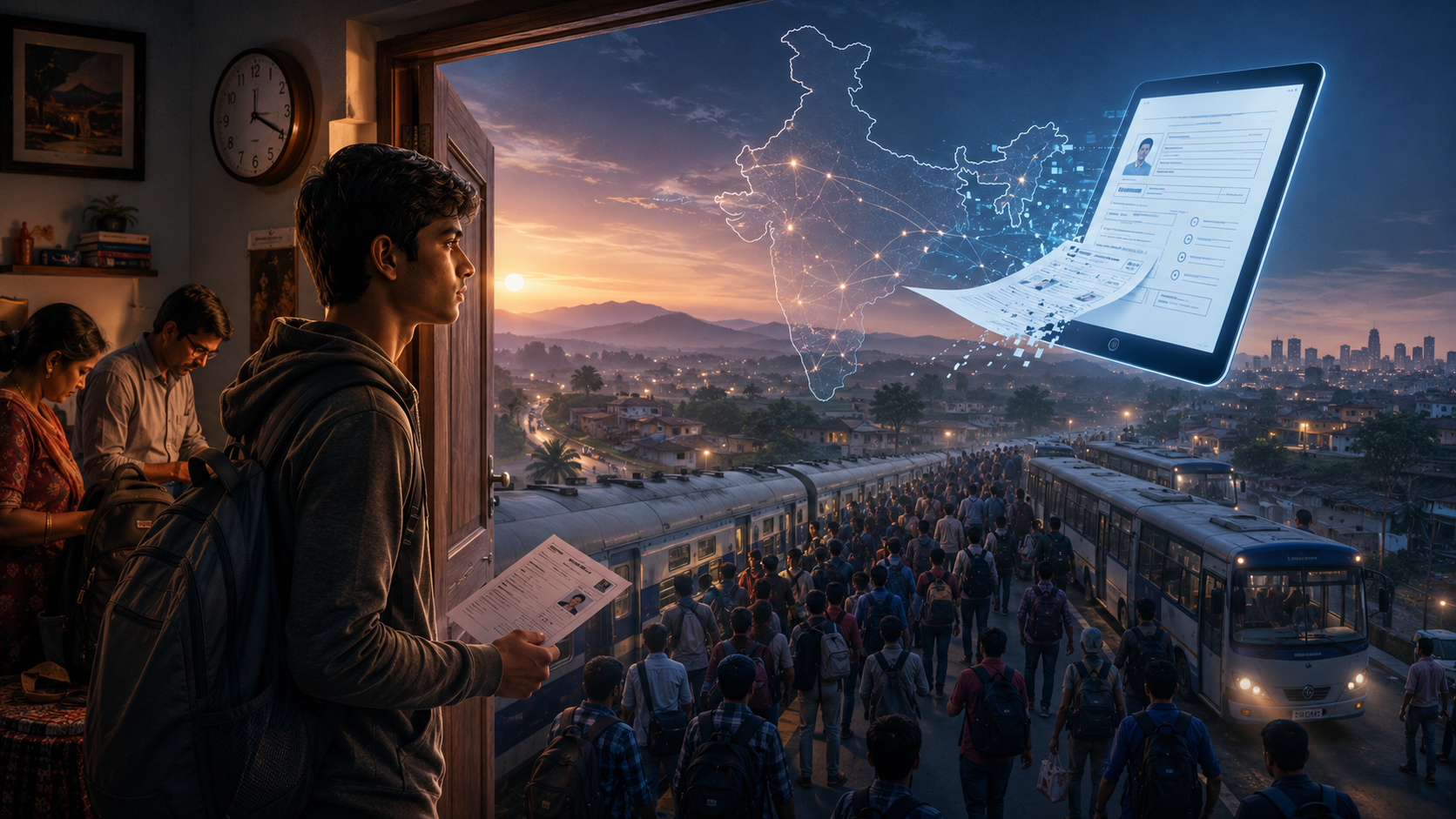
The alarm shrills at 4am. Clothes, ironed the night before, lie ready. The admit card — printed, laminated, triple-checked — waits by the door. Across India, the same ritual unfolds in tens of thousands of homes: hopeful youth rise before dawn, sling bags over shoulders, catch the first bus or train to an exam centre in a city they may have never visited, and sit for three hours answering questions that could change everything.For generations of Indian students, this pilgrimage is simply part of the deal. The entrance exam experience, with its pre-dawn logistics, unfamiliar cities, and budget lodge check-ins, has become as much a rite of passage as the exam itself. NEET alone draws approximately 15 lakh students every year, and JEE Main sees between 10 and 12 lakh takers annually. Add in CUET, CLAT, CAT, and a constellation of state-level tests, and India is running what is arguably the largest paper-based examination ecosystem on earth — year after year, season after season, mostly unchanged.But the question gathering quiet momentum in policy circles, classrooms, and edtech boardrooms alike is a simple one: does it still need to be this way?In Estonia, national exams are taken on a laptop. In Australia, students in remote towns log into the same test as their urban peers from a local school computer. JEE Main itself has run in computer-based mode for years, largely without incident. The technology exists. The internet penetration, while uneven, is broader than it has ever been.And the appetite for reform, sharpened by years of logistical strain and questions about exam integrity, has rarely been stronger.India has built a digital payments system the world envies and a tech industry that powers Silicon Valley. The question is whether it can extend that ambition to the exam hall.
The case for going digital
The most obvious argument for online entrance exams is also the least glamorous: paper. India prints millions of question papers every exam season, each one a logistical and environmental liability. They have to be physically produced, sealed, transported under security, distributed to hundreds of centres, and then destroyed. The carbon footprint of running a single national exam, from printing to transit to disposal, is considerable. Going online eliminates that chain almost entirely.Then there is the question of cost. Traditional exams are expensive in ways that rarely make headlines: invigilators, administrators, hired venues, security personnel, printed stationery, and the enormous coordination machinery that holds it all together. An online system, once built and stabilised, dramatically reduces these recurring expenses. The savings, in theory, could be redirected toward better infrastructure or wider access.
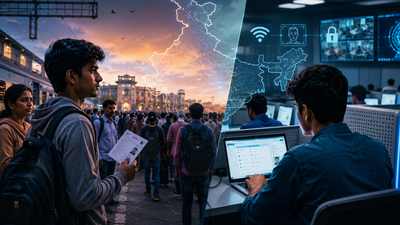
AI generated image
Speed is another quiet advantage. Results that currently take weeks to process could, in an online system, be generated almost instantly. Automated grading removes human error from the equation and, in a country where re-checking and answer key disputes have become a ritual post-exam exercise, that is no small thing.Security, too, is more nuanced than the sceptics allow. Critics point out that digital cheating exists, and they are right. But online proctoring has advanced considerably: AI-based monitoring, randomised question sets, live video surveillance, and browser lockdowns make coordinated malpractice significantly harder to execute at scale. The weakness of a paper exam is that one leaked set of questions compromises every candidate sitting it. In a well-designed online system, no two students need to see questions in the same order, or even the same questions at all.And perhaps most importantly, an online exam meets students where they already are. This is a generation that books train tickets, files forms, and consumes entire syllabi on their phones. Asking them to demonstrate their knowledge on a screen is not a radical departure, in many ways, it is simply catching up.For Biva Jha, a science teacher at Bishop Scott Senior Secondary School in Patna, the answer is not straightforward. “Whether online exams help or hurt depends on various factors, reliable internet connections, electricity, computer facility, digital literacy, and a quiet place to conduct the exam,” she says. But she is not dismissive of the idea either.For students in areas like Bihar, where many travel hours to reach an exam centre, the relief of a local alternative is real. “Online exams help by reducing travel costs, accommodation expenses, and stress, especially for students from rural areas who currently travel long distances to exam centres,” she adds.
The case against — and why it cannot be ignored
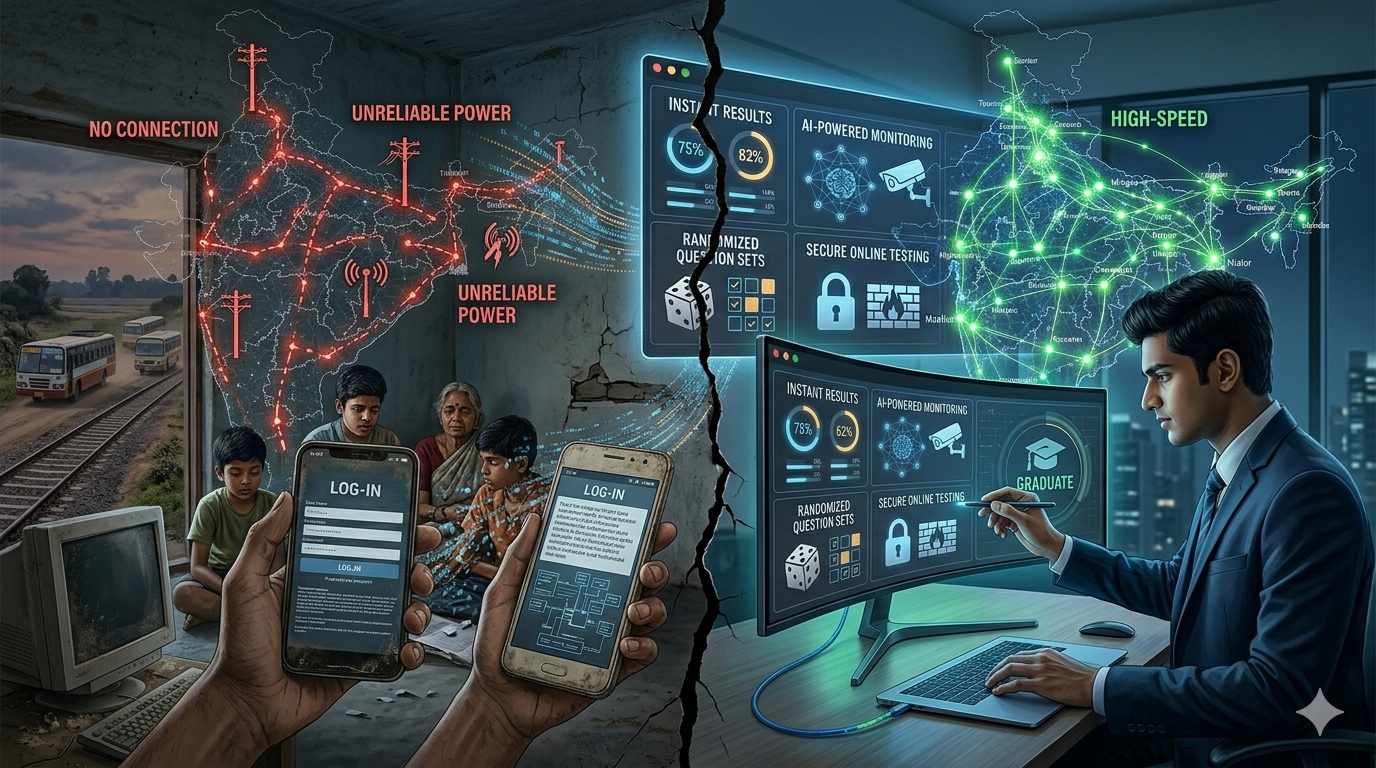
For all its promise, the shift to online exams runs headlong into a problem that India has never quite solved: the country is not one place. Between a student in South Mumbai with a fibre connection and a laptop and one in rural Jharkhand sharing a single smartphone with three siblings, the word “online” means entirely different things. Mandating a digital exam without first closing that gap does not modernise the system, it simply relocates the inequality.The infrastructure problem is not just about internet connectivity, though that is the most visible piece. It extends to electricity supply, access to a functioning computer, and something as basic as a quiet room. In many households, especially in smaller towns and villages, none of these can be taken for granted simultaneously. An exam that requires all four at once, on a specific date and time, asks a great deal of families who have very little margin for error.
AI generated image
Then there is the question of familiarity. A student who has spent three years preparing on paper, solving problems by hand, annotating margins, crossing out wrong answers, is being asked, at the most consequential moment of their academic life, to perform in a format they may have rarely practised. That is not a trivial adjustment. Comfort with a medium affects performance in ways that have nothing to do with subject knowledge, and any system that conflates the two is not measuring what it claims to measure.Cheating, too, does not disappear online, it evolves. Screen sharing, remote access software, impersonation through proxy logins, smartwatches discreetly consulted under a desk: the methods shift, but the incentive remains the same. In a country where the stakes of a single exam can define a family’s trajectory for a generation, the pressure to cheat is structural, not just individual. Better proctoring technology helps, but it is not a complete answer.And finally, there is the grading problem that rarely gets discussed. India’s entrance exams are overwhelmingly multiple choice precisely because automated scoring is clean and fast. But educators have long argued that MCQ-only formats test a narrow slice of intelligence, recall and elimination, more than reasoning or expression. Moving online does nothing to fix that. If anything, it risks locking in a format that was chosen for logistical convenience rather than pedagogical merit.Biva Jha is clear-eyed about where the system would crack first. “In India, digital access is not equal across regions and income groups,” she says. Before any large-scale shift online, she argues, the groundwork has to be laid. “Governments and institutions may need to invest in digital infrastructure of all the rural areas of India before fully shifting online.”And even where access exists, familiarity is a separate problem altogether. A student who has never sat in front of a computer does not just face a learning curve, they face it on the worst possible day. “That will affect the performance of a student despite having the same knowledge,” Jha says plainly. The disadvantages are specific and practical: “A student who has never used a computer faces difficulty in typing, slow typing, struggles to handle digital diagrams, switch the questions, and is unable to use onscreen calculators.” The result, she suggests, is a system that may end up measuring tech confidence as much as academic ability. “They may perform worse despite having the same subject knowledge.”The debate around online exams is ultimately not a technological one, it is a question about who the system is designed to serve. Until a student in a Bihar village and one in a Bengaluru apartment can sit the same digital exam with the same degree of confidence, the shift will remain incomplete. The answer, most likely, is not paper or screen, it is both, for now, and better of each than what exists today.