
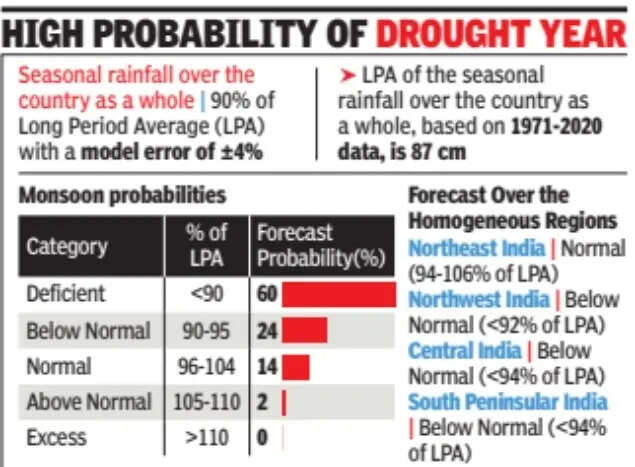
NEW DELHI: Even as India faces energy disruptions due to the West Asia crisis, more trouble could be looming for the economy. IMD on Friday confirmed its forecast of ‘below normal’ monsoon rainfall this year while further downgrading the extent of rains during the June-Sept season, with a high probability of ‘deficient’ rainfall, also known as a drought year.Rainfall during the season is likely to be 90% of long period average (LPA) – revised down from 92% predicted in April – with a 60% chance of ‘deficient’ rainfall (less than 90% of LPA), according to IMD, a situation that may not just impact the farm sector but also negatively affect water reservoirs, groundwater recharge and hydro-power potential, triggering crises at multiple levels.
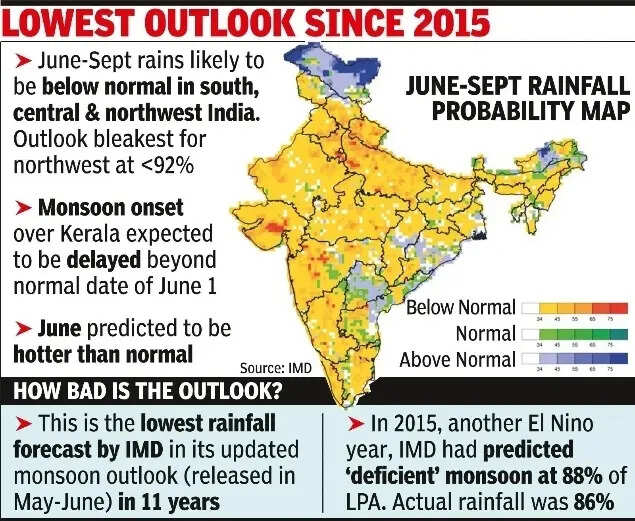
IMD attributed the monsoon downgrade to a likely development of strong El Nino conditions – a climatic phenomenon of warming of ocean waters in central and eastern equatorial Pacific – which is more often than not associated with a harsh summer and weak monsoons in India.IMD, accordingly, also indicated a hot June in the country, predicting ‘above normal’ heatwave days over many parts of UP, Haryana, Punjab, Bihar, Odisha, Chhattisgarh, Gujarat and Andhra Pradesh and parts of Maharashtra, Telangana, Himachal Pradesh and Tamil Nadu in June. Rajasthan and Jharkhand may, however, experience ‘below normal’ heatwave days during the month.The latest climate model forecasts indicate that El Nino conditions are likely to develop during the southwest monsoon season,” said IMD chief Mrutyunjaya Mohapatra, noting how the formation is expected to gradually evolve from weak in June to moderate in July-Aug and strong in Sept, impacting the entire rainy season.Such a scenario, along with the possibility of a slight delay in monsoon onset over Kerala against the normal date of June 1 and its subsequent progress over the rest of the country, may also delay the start of sowing operations, as more than half of India’s cultivated area remains rain-fed.Though IMD a few days ago predicted May 26 (with a model error of +/- four days) as the monsoon onset date over Kerala, it now expects it to happen any day within the next seven days. Since the ‘monsoon core zone’ – a region comprising most of central and western India, which largely depends on rains for farming operations – is also predicted to get ‘below normal’ rainfall, its impact will be felt on the overall acreage of kharif crops and their final output.The risks in the country’s farm sector may further be compounded by the crisis in West Asia that has already put pressure on the availability of inputs (diesel and fertilisers) and their costs, casting a shadow over the rural economy and eventually over India’s economy in the current financial year.
Union agriculture minister Shivraj Singh Chouhan, however, said the nation is fully prepared to deal with any eventuality and is ready with contingency measures in terms of opting for drought-tolerant and climate-resilient crop choices (such as millets and less water-consuming varieties of paddy, other crops) in vulnerable districts and other interventions like making adequate input (seeds and fertilisers) available to farmers.Contingency measures largely include promotion of drought-tolerant crop varieties, weather-based agro-advisory services, efficient water management and location-specific adaptation strategies to minimise agricultural losses and safeguard farmers’ livelihoods.Chouhan asked state govt’s to brace for the challenging weather conditions in view of the El Nino threat and assured them of all help from the central govt, asserting that there was adequate availability of seeds and fertilisers to meet demand during the upcoming sowing season.The minister, during the concluding day of a national conference on kharif preparedness amid the growing risk over farming operations due to El Nino on Friday, also asked states to prepare their own agriculture roadmap based on agro-climatic conditions, available resources and local potential.