


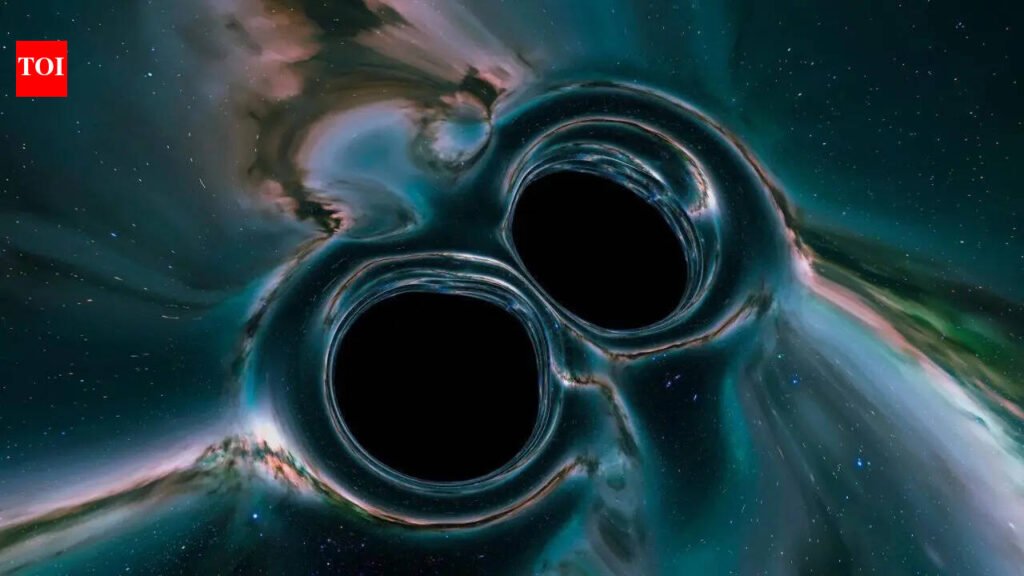

The Universe keeps throwing up surprises, and black holes are right at the centre of it. The biggest ones detected so far do not seem to fit the usual story of how stars die. A new study reportedly suggests that these extreme objects might not form in a single collapse at all. Instead, they could grow step by step inside dense star clusters, where gravity constantly pulls objects into close contact. Scientists analysing gravitational-wave data from LIGO–Virgo–KAGRA believe repeated mergers might be the real engine behind these giants, as reported by ScienceDaily. It is a messy, violent idea. Black holes colliding again and again, slowly building something far larger than any single star could ever create. And the more the data is studied, the more this pattern seems to stand out.
How black holes form, merge, and grow inside dense globular clusters
Globular clusters can be considered some of the most densely packed parts of space. In this place, hundreds of thousands of stars are concentrated within a small radius, held together by gravity. According to Cardiff University, one example of such a globular cluster is the star cluster M80, which is estimated to be at a distance of 28,000 light-years from Earth. The area of a globular cluster is highly unstable and dynamic.Within such an environment, black holes cannot stay separated for a long period of time. Black holes move around, interact with each other, and merge. Scientists believe that such an environment can facilitate black hole mergers through natural processes. The process itself is not smooth; it occurs through millions of years of gravitational interactions. The study group analysed data on 153 black hole mergers that were recorded in the GWTC4 catalogue. This database includes observations of gravitational waves that occur due to collisions of celestial bodies such as black holes.What the scientists found was a clear split between two types of black holes. One group appeared lower in mass, with slow and fairly orderly spins. These are thought to come from ordinary stellar collapse, where a massive star reaches the end of its life and forms a black hole.The second group looked very different. These black holes were heavier and had faster spins. Their spin directions also seemed random rather than aligned. According to researchers, this is an important clue. It might indicate that these objects did not form in a single event but were instead built through multiple mergers inside dense star clusters.
Why the black hole mass gap exists and what it reveals about cosmic collisions
According to the study published in ScienceDaily, titled, ‘The Universe’s biggest black holes may be forged in violent mergers‘, another interesting feature in the data is something scientists call the “mass gap”. This is a range of black hole masses where, in theory, objects should not exist if they formed directly from collapsing stars.Stars above a certain size are expected to explode in such a powerful way that no black hole is left behind. This process, linked to pair-instability, should create a gap around a particular mass range. However, the study identifies black holes near and above roughly 45 times the mass of the Sun sitting in or close to this gap. That challenges long-standing models of stellar evolution.Researchers suggest that these heavy black holes might not have formed directly from stars at all. Instead, they may be the result of earlier black hole mergers, built up step by step inside dense clusters where interactions are frequent.
How repeated black hole mergers build larger and faster-spinning cosmic objects
The concept of such a model is relatively easy to grasp, although the process itself is very brutal. First of all, there emerges a black hole out of a dead star, which later travels into a tight group of black holes. There, it finally encounters another black hole with which it unites. A new, bigger black hole will not cease its existence here; in fact, the cycle can be resumed again, giving rise to an increasingly massive and fast-spinning black hole.It is considered that this phenomenon might give some clues on the peculiarities of supermassive black holes detected by gravitational waves, since their patterns of spins and masses clearly suggest multiple collisions rather than the creation of one.
What this means for black hole research
This study, led by Cardiff University researchers, adds a new layer to how scientists understand black hole growth. Gravitational-wave astronomy is still a relatively young field, but it is already reshaping long-held assumptions about the Universe.It now appears that black holes might not just be the final stage of a dying star. In some cases, they could be part of a much longer chain of cosmic evolution inside star clusters. A kind of slow assembly process driven by gravity, collisions, and time. The Universe, it seems, is not only creating black holes. It is also recycling them, again and again, inside some of its most crowded environments.


