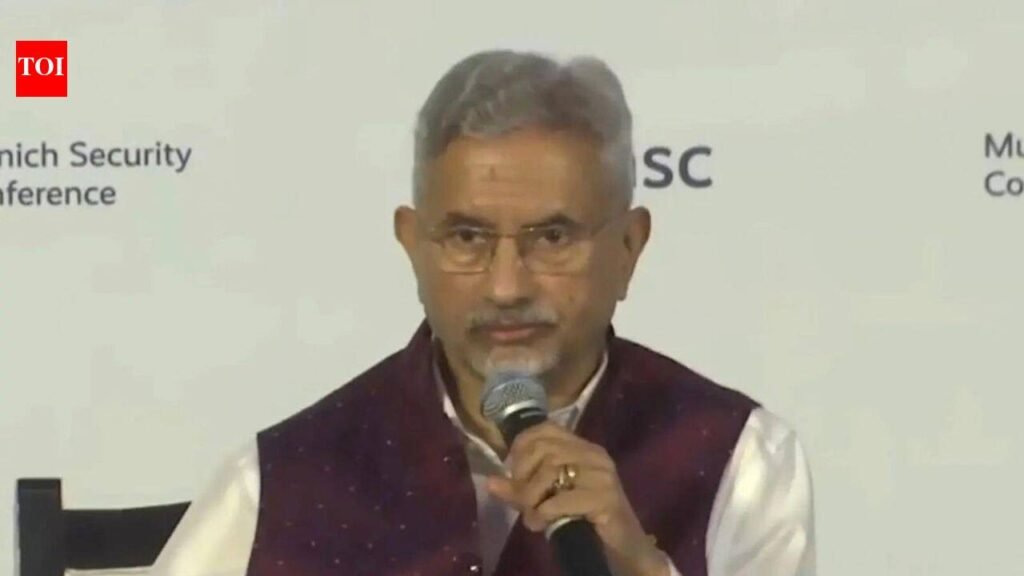
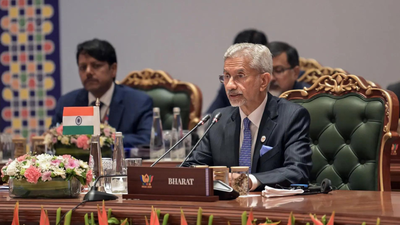
NEW DELHI: External Affairs Minister S Jaishankar on Thursday took a veiled swipe at the US over its sanctions-led foreign policy, cautioning against “unilateral coercive measures” as India voiced concern over the worsening West Asia crisis and its fallout on global energy and trade routes.Speaking at the opening session of the BRICS foreign ministers’ conclave, Jaishankar said sanctions and coercive measures that bypass international law end up hurting developing nations the most.“Such measures disproportionately affect developing countries. These unjustifiable measures cannot substitute dialogue, nor can pressure replace diplomacy,” he said, without naming any country directly.The minister also warned that continuing tensions in Middle East, particularly around key shipping lanes and energy infrastructure, were creating serious global risks.“The conflict in West Asia merits particular attention. Continuing tensions, risks to maritime traffic, and disruptions to energy infrastructure highlight the fragility of the situation,” Jaishankar said.He stressed that uninterrupted maritime movement through critical waterways such as the Strait of Hormuz and the Red Sea was essential for global economic stability. Pitching for diplomacy over confrontation, Jaishankar said respect for sovereignty and territorial integrity must remain the foundation of international relations.“Stability cannot be selective, and peace cannot be piecemeal. It is essential to uphold international law, protect civilians, and avoid targeting public infrastructure,” he said.Jaishankar added that India was ready to support efforts aimed at reducing tensions in the region and restoring stability.The external affairs minister also raised concerns over Gaza, calling for a sustained ceasefire, humanitarian access and progress towards a two-state solution.Besides Gaza, he referred to the crises in Lebanon, Syria, Sudan, Yemen and Libya, urging coordinated international engagement to address them.The India-hosted BRICS meeting comes amid mounting concerns over energy supply disruptions and wider economic uncertainty triggered by the ongoing West Asia conflict.Among those attending the conclave are Iranian Foreign Minister Abbas Araghchi, Russian Foreign Minister Sergey Lavrov, Brazilian Foreign Minister Mauro Vieira, Indonesian Foreign Minister Sugiono and South African minister Ronald Lamola.Jaishankar also reiterated India’s position on terrorism, saying “cross-border terrorism violates the basic principles of international relations” and that “zero tolerance must remain an uncompromising and universal norm.”