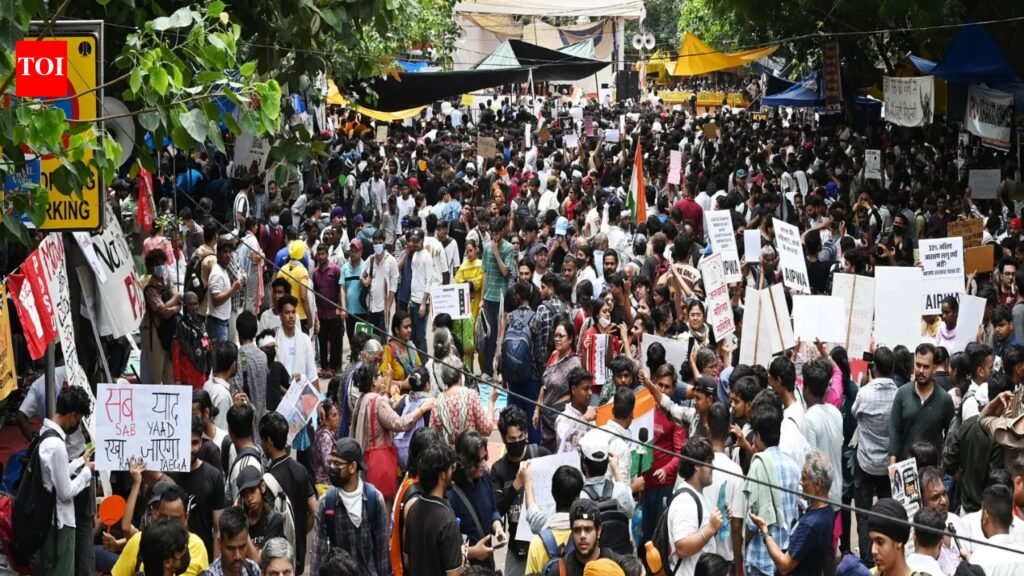
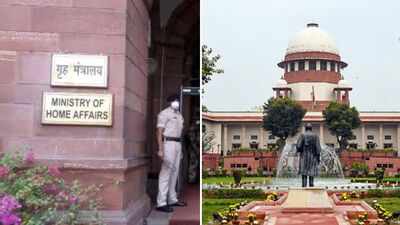
NEW DELHI: Continuing with its tough stand against protesters, the home ministry Thursday sought modification of Supreme Court’s Oct 11 order for allowing “unhindered internet services” and said exigencies such as disturbance of public order required temporary suspension of cellular internet services, as was the case between 10 pm on Oct 9 to 10 pm on Oct 10 in a 4-km radius of Raisina Hill.In an affidavit filed in response to a contempt of court notice, home secretary Govind Mohan justified Delhi Police’s request for suspension of cellular internet services and said it was “found to be a proportionate measure, having regard to the magnitude of the situation and the need to prevent any disturbance of public order in the national capital”.“The suspension was confined to cellular internet services and did not extend to non-cellular internet services or telecommunications services such as wi-fi and broadband,” he said, emphasising that suspension of such services was considered a recognised measure to maintain public order in appropriate circumstances.The home secretary, Delhi Police commissioner and DMRC chairperson tendered unconditional apology to the court through their affidavits before going on to explain why the steps were taken to prevent unlawful gathering at Jantar Mantar on Oct 10.Though the affidavit conveyed an “unconditional apology“ to the court for the “contempt” charge, it marked a defiant assertion of the Centre’s legal competence and willingness to take strong measures to control “illegal“ protests.Solicitor general Tushar Mehta told a bench of Chief Justice Surya Kant and Justice Joymalya Bagchi that the “apology” was meant to meet a procedural requirement. “The law is well settled that whenever response is filed pursuant to contempt notice, first sentence we write is that we hereby tender an unconditional apology. And thereafter, we have explained how the contempt is not made out,” he said.“It is with reference to compliance of that law that in every affidavit, this is the first paragraph. Now, in media and social media, things are going on that govt has apologised and they want to say nothing,” he complained.CJI Kant said, “We have not read those media reports, nor are we taking cognisance of any such report.” Justice Bagchi added, “We are neither taking cognisance of the media reports nor your unqualified apology. But by your submissions, it appears to be a qualified apology.”Delhi Police commissioner Anurag Kumar said in his affidavit that permission for the CJP’s Oct 10 protest at Jantar Manor was denied due to past experience of large-scale violence during its July 20 protests, inability of organisers to control supporters and the grave inconvenience caused to general public because of a string of protests from Oct 6-8 that choked central Delhi for days together.Narrating the sensitivity of central Delhi, housing Rashtrapati Bhavan, Parliament, Supreme Court, embassies and other institutions requiring a complex security arrangement as well as measures for maintaining public order, the commissioner said, “No police administration can permit any breach of public order in the national capital, particularly when a call is given by an organisation with a recent history of mob violence, and incidents resulting in injuries to several individuals and the subsequent events of Oct 6, 7, 8.”He added, “Due to all these marches, central Delhi areas got completely choked and there were huge traffic snarls for long hours, resulting in students and innocent citizens getting stuck in traffic jams, resulting in them missing their trains, airlines etc.