


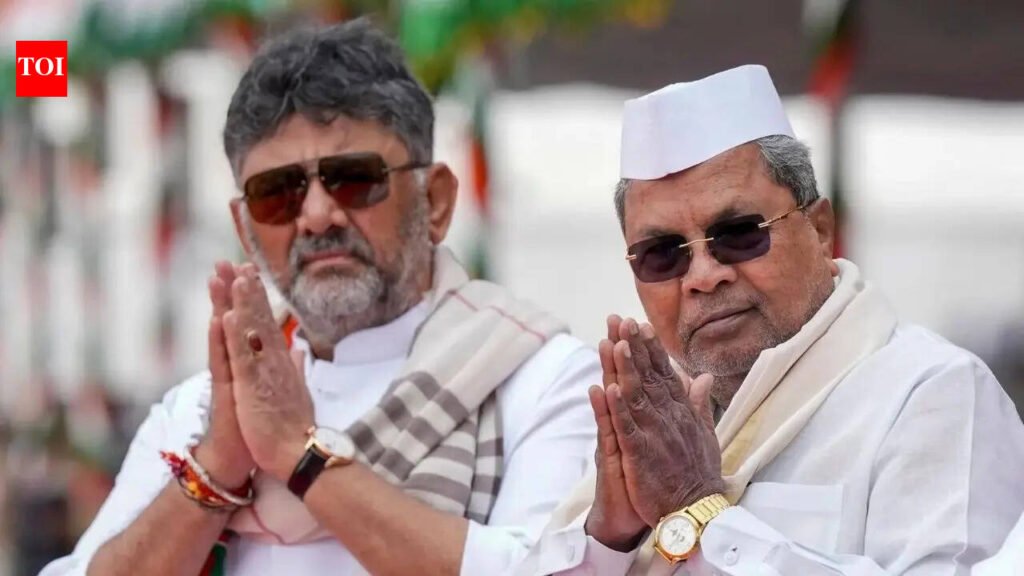

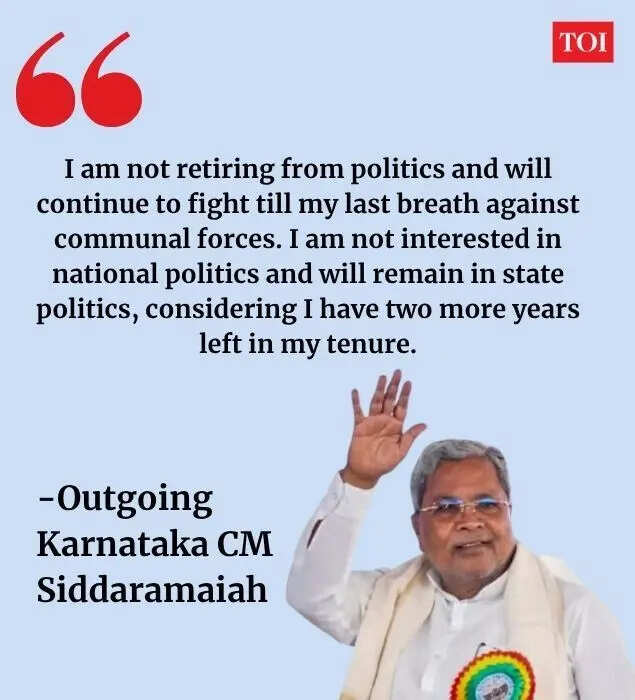
NEW DELHI: The Congress leadership had designed Siddaramaiah‘s exit from the Karnataka chief minister post to appear orderly, disciplined and final.A resignation in Bengaluru. A Rajya Sabha berth in Delhi. A graceful transition from state strongman to senior national statesman.Instead, Siddaramaiah accepted only the first part.Minutes after submitting his resignation letter as Karnataka CM on Thursday, the veteran Congress leader publicly announced that he had rejected the party leadership’s offer to move to Rajya Sabha, making clear that he intended to remain in Karnataka politics.“I am not interested in national politics,” Siddaramaiah bluntly said, seated beside his likely successor, DK Shivakumar. “I will remain in state politics,” he asserted.

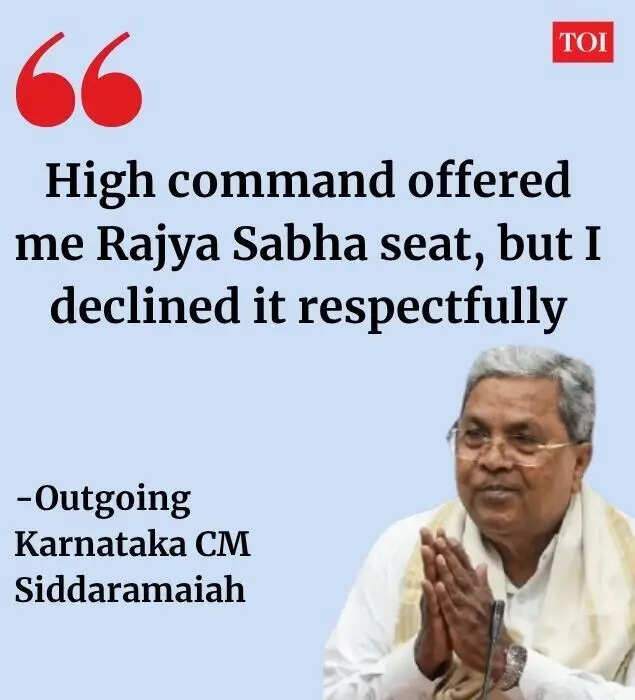
The resignation itself had long appeared inevitable amid the Congress party’s unresolved power-sharing arrangement in Karnataka. But Siddaramaiah’s refusal to relocate to Delhi altered the meaning of the transition entirely.What was expected to be a carefully managed transfer of power has instead exposed a more complicated political reality inside the Karnataka Congress: Siddaramaiah may have surrendered the CM office, but he has not surrendered influence.But what is behind his “polite” dissent with the Congress high command?
‘A natural refusal’
Political analyst Sugata Srinivasaraju suggests the refusal should not be read as dramatic rupture but as structural realism.“There’s no special reason that I read as to his refusal. It’s quite natural … because he is not a Hindi-speaking person, or he would be a fish out of water in Delhi,” he said.

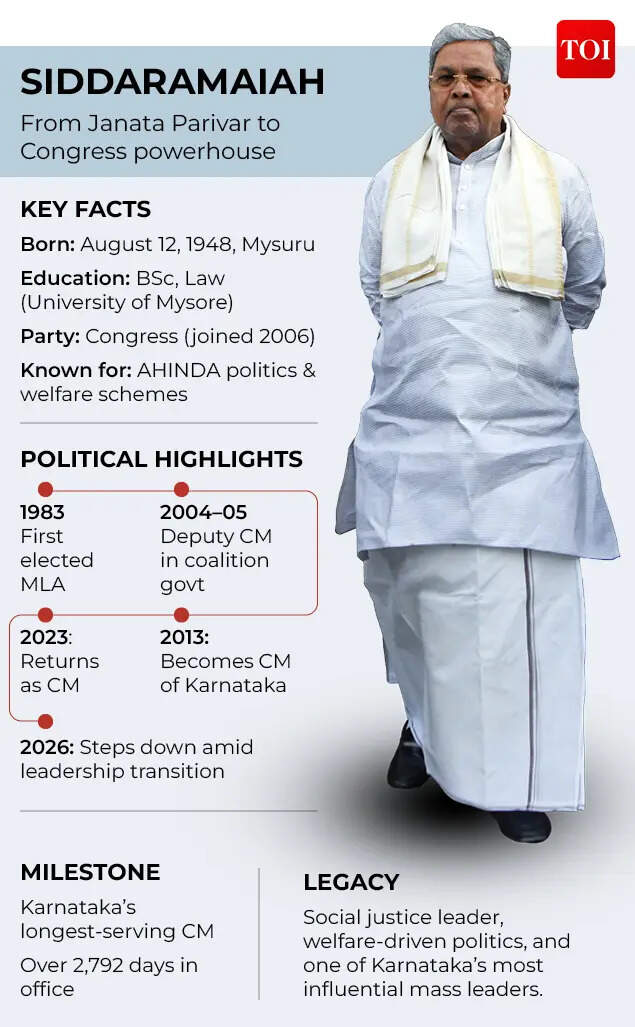
Srinivasaraju argued that Siddaramaiah’s political identity was never designed for the national arena.“I don’t think he has built his network in the national capital. At his age (78), you cannot start building a network there or build ambition in Delhi,” he said.“If he was a Hindi-speaking person, probably there were some opportunities. It’s not so with Kharge,” he said adding: “Kharge came from the Urdu belt, the Hyderabad belt, and he knew the language well. He always had a pan-India feel for the party.”Siddaramaiah, by contrast, remained rooted in Karnataka.“He has been a local leader. He came from the Janata Parivar. I don’t think he has pan-India ambitions at all. He wouldn’t fit into that role,” Srinivasaraju said.
The logic of staying back
Beyond identity and language, Srinivasaraju pointed to more pragmatic considerations — particularly the relationship between power and proximity.“He has to settle a lot of things here … extend patronage to his supporters, and his son’s career has to be made,” he said. He also raised questions about internal bargaining within the Karnataka Congress.“If you control the levers of power here, and with your set of MLAs always trying to keep DK Shivakumar on the edge, he may be more obliging,” he said. “We also don’t know what leverage DK has over this man for him having so meekly surrendered power. He has never been known to give up power so easily,” Srinivasaraju pointed out.
Shivakumar’s moment and its limits
For DK Shivakumar, the transition is both an ascent and an unfinished consolidation.After years of organisational work and repeated claims to leadership, he is now positioned to take over as chief minister. But unlike a clean succession, this one arrives with residual power centres still active inside the system.Siddaramaiah’s decision to remain in Karnataka politics means Shivakumar is unlikely to inherit an uncontested structure.Within Congress, leaders aligned with Siddaramaiah continue to occupy significant positions in the legislature and organisation. Reports also suggest that the incoming government may include multiple deputy chief ministers representing backward classes, Dalits, Scheduled Tribes and minority communities – groups central to Siddaramaiah’s AHINDA coalition.

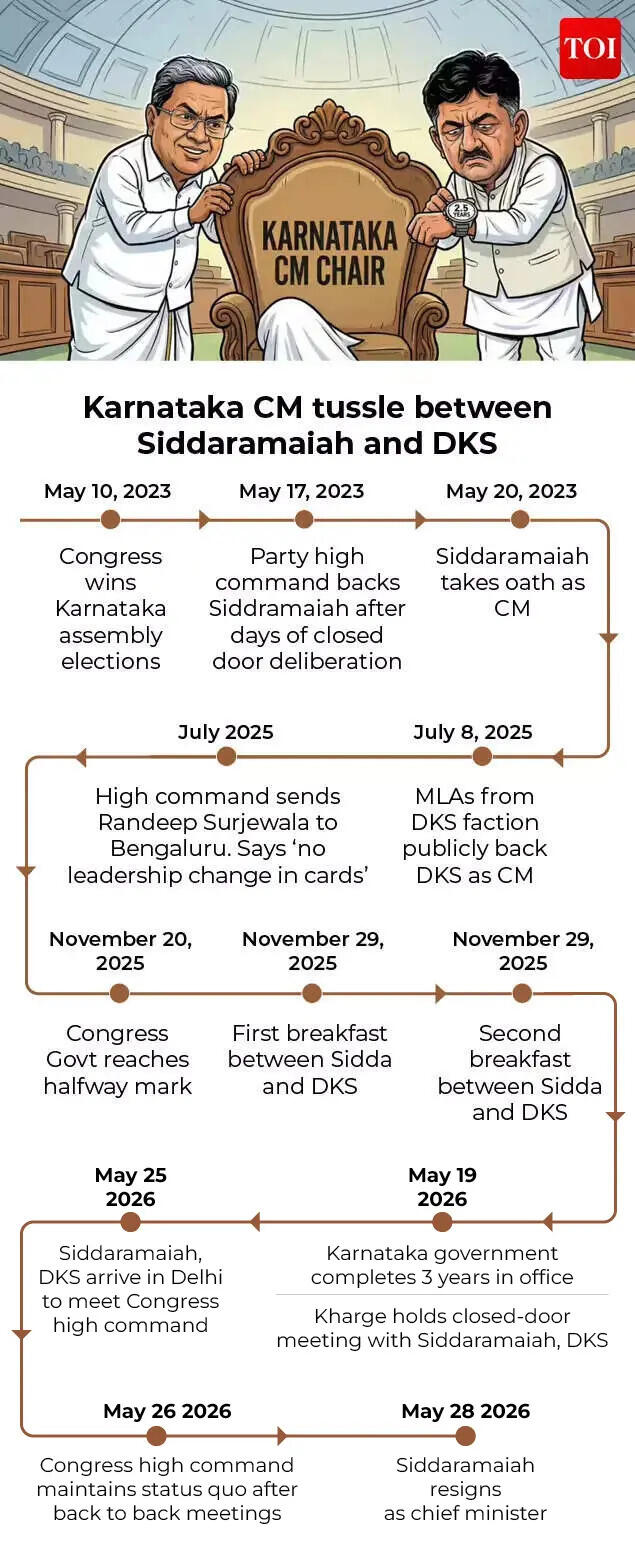
That arrangement is widely seen as both social balancing and internal accommodation.For Shivakumar, it creates a governance structure that is formally hierarchical but politically distributed.His challenge will be to assert authority without triggering factional rupture — and to do so while managing expectations from both the high command and competing regional blocs.
A managed transition, not a clean handover
Srinivasaraju remains sceptical of reading Siddaramaiah’s exit as a dramatic political turning point.“It’s usual, right?” he said of Siddaramaiah’s farewell tone, adding: “He is trying to claim some legacy — or an exit that is non-existent.”Even the emotional framing of obedience to the high command, he suggested, may be more tactical than symbolic.
“He wants to now say he is a loyal Congressman who heeded Rahul Gandhi’s request to give up the chair. He has never done that in his life,” Srinivasaraju said.Recalling Siddaramaiah’s long political journey, he pointed to earlier ideological and organisational conflicts. “He has always been someone who fought for power rather than surrendered it,” Srinivasaraju said.
The question of 2028
Siddaramaiah’s decision to stay in Karnataka may also be shaped by a longer political horizon: the 2028 assembly elections.Candidate selection remains one of the most important instruments of power inside Indian political parties. Leaders who influence ticket distribution effectively shape the next generation of legislators and future factional alignments.Had Siddaramaiah moved to Delhi, his ability to influence those decisions would almost certainly have weakened over time.By remaining in Bengaluru, he retains proximity to the organisational machinery that will determine Congress’s electoral strategy in the state.For MLAs aligned with him, his continued presence serves as political insurance. It assures them that their future inside the party does not depend entirely on adjusting to a new leadership structure.It also keeps open the possibility — however distant — of Siddaramaiah himself re-emerging as a central political figure if circumstances shift before 2028.He has explicitly ruled out retirement. “I am going to fight till my last breath,” he said.Political analyst Srinivasaraju, however, remains unconvinced.“Two years is far away, and I don’t see that energy in him to go into the next election as a chief ministerial candidate. DK by then would have run the state for two years,” he said. “There will be other leaders coming up,” Srinivasaraju said.He also pointed to structural electoral pressures facing the Congress.“With Gen Z pressure entering political parties, I don’t think they will go back to Siddaramaiah,” he said.For now, Siddaramaiah has conceded the CM chair but refused to move out. As Karnataka Congress enters this new phase of shared authority and competing power centres, it is yet to see of Siddaramaiah’s refusal was a tactical pause or the beginning of a longer political recalibration within the party.


