


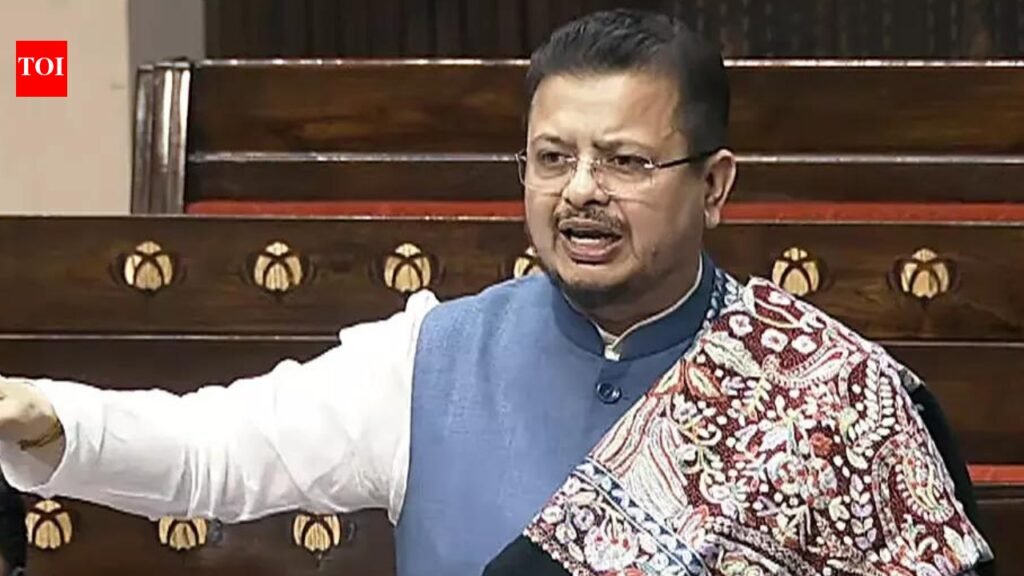

In a major escalation of the crisis within the Trinamool Congress (TMC), expelled party leader Ritabrata Banerjee on Wednesday claimed that Assembly Speaker Rathindra Bose had recognised him as the leader of the opposition in the West Bengal Assembly and accepted the rebel camp’s claim to legislature party status.Addressing a press conference, Banerjee said the rebel faction represented the “real and main opposition” in the Assembly and announced a new leadership structure. He named Javed Khan, Sandipan Saha, Sabina Yasmin and Shiuli Saha as deputy leaders of the legislature party.The development comes after 58 rebel MLAs submitted letters of support to the Speaker, comfortably crossing the two-thirds threshold required under the anti-defection law for a breakaway faction to avoid disqualification. The group has proposed Banerjee as legislature party leader and Akhruzzaman as chief whip.While openly challenging the authority of TMC national general secretary Abhishek Banerjee, the rebels stopped short of directly confronting ex-chief minister Mamata Banerjee. Banerjee said he wanted Mamata Banerjee to serve as the chief adviser of the legislature party, while the rebel camp continued to recognise her as party chairperson.The revolt, triggered after the TMC’s defeat in the recent Assembly elections, is widely viewed as the biggest internal challenge faced by the party since its formation. In response, the TMC has dissolved all organisational committees across West Bengal and announced a review of its party structure.
Who is Ritabrata Banerjee, the face of the TMC rebellion?
Ritabrata Banerjee’s emergence as the leader of the rebel camp marks another dramatic turn in a political career defined by sharp ideological shifts and repeated clashes with party establishments.The 46-year-old first rose to prominence as general secretary of the Students Federation of India (SFI), the student wing of the Communist Party of India (Marxist), and was regarded as one of the Left’s most promising young leaders. In 2014, he entered the Rajya Sabha with CPI(M) support and was considered close to senior leaders including Buddhadeb Bhattacharjee and Sitaram Yechury.However, allegations of indiscipline and factionalism led to his suspension and eventual expulsion from the CPI(M) in 2017, bringing an abrupt end to what many in the party had seen as a promising political career.After a brief period on the political sidelines, Banerjee moved closer to the TMC and formally joined the party in 2020 following the completion of his Rajya Sabha term. Within the party, he quickly regained influence, heading the Indian National Trinamool Trade Union Congress (INTTUC), securing another Rajya Sabha berth in 2024 and later winning election to the Assembly.His rise within the TMC made his role in the current revolt particularly striking. Once viewed as part of the party’s inner circle, Banerjee is now leading the biggest internal challenge faced by the party since its formation, with the rebel camp claiming the support of 58 MLAs and control of the legislature party.“This is perhaps the only major Bengal politician who has been expelled by both the CPI(M) and the TMC,” quipped a veteran political observer, as quoted by PTI.The developments have drawn comparisons with Maharashtra’s 2022 political upheaval led by Eknath Shinde, where legislative strength became the basis for a challenge to the party leadership.


