


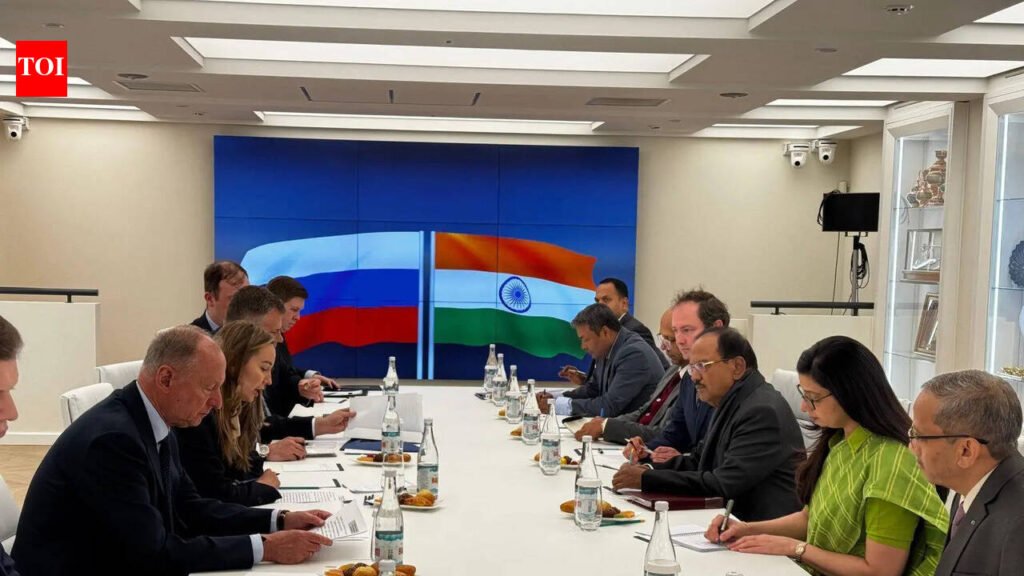

National Security Advisor Ajit Doval met with Russian officials in Moscow on Friday, reviewing progress on key bilateral initiatives in maritime connectivity, shipbuilding, defence collaboration, and training of sailors for polar operations.Doval held talks with Nikolai Patrushev, Aide to the President and Chairman of the Maritime Board of Russia, assessing proposals discussed during Patrushev’s visit to New Delhi in November 2025.The two sides also exchanged views on regional and global developments, the Embassy of India in Russia said.Earlier in the day, Doval met First Deputy Prime Minister Denis Manturov, reviewing bilateral cooperation in defence, energy, space and other fields. The Russian side organised a visit to their National Space Centre and the Roscosmos Joint Industry Information Centre.Doval also met his counterpart Sergei Shoigu, Secretary of the Security Council of Russia, on the sidelines of the first International Security Forum, reviewing ongoing cooperation in defence, security, energy and economic ties. The two sides also discussed the upcoming BRICS NSA meeting in New Delhi, the embassy said.In his speech at the forum, Doval called for special attention to the situation in West Asia, emphasising the need to ensure safe and uninterrupted flow of trade through international waterways, including the Strait of Hormuz and the Red Sea.“Safe and uninterrupted movement of international trade through international waterways is essential for the global economy. India stands ready to contribute constructively to support all efforts to reduce tensions and help restore stability,” Doval said.He expressed concern over disruption in oil and gas supply affecting the global economy.On the sidelines of the forum, Doval also met Tin Aung San, National Security Advisor of Myanmar. They reviewed cooperation in security, defence, connectivity and other fields, and exchanged views on regional developments. Myanmar’s NSA will visit India for the 5th BIMSTEC NSAs meeting in July.The Arctic route, promoted by Russia as an alternative Asia-Europe corridor, could reduce shipping times and give India greater access to Arctic resources and trade networks. This aligns with India’s aim to diversify maritime links away from chokepoints such as the Suez Canal and Strait of Hormuz.Based on inputs from ANI


